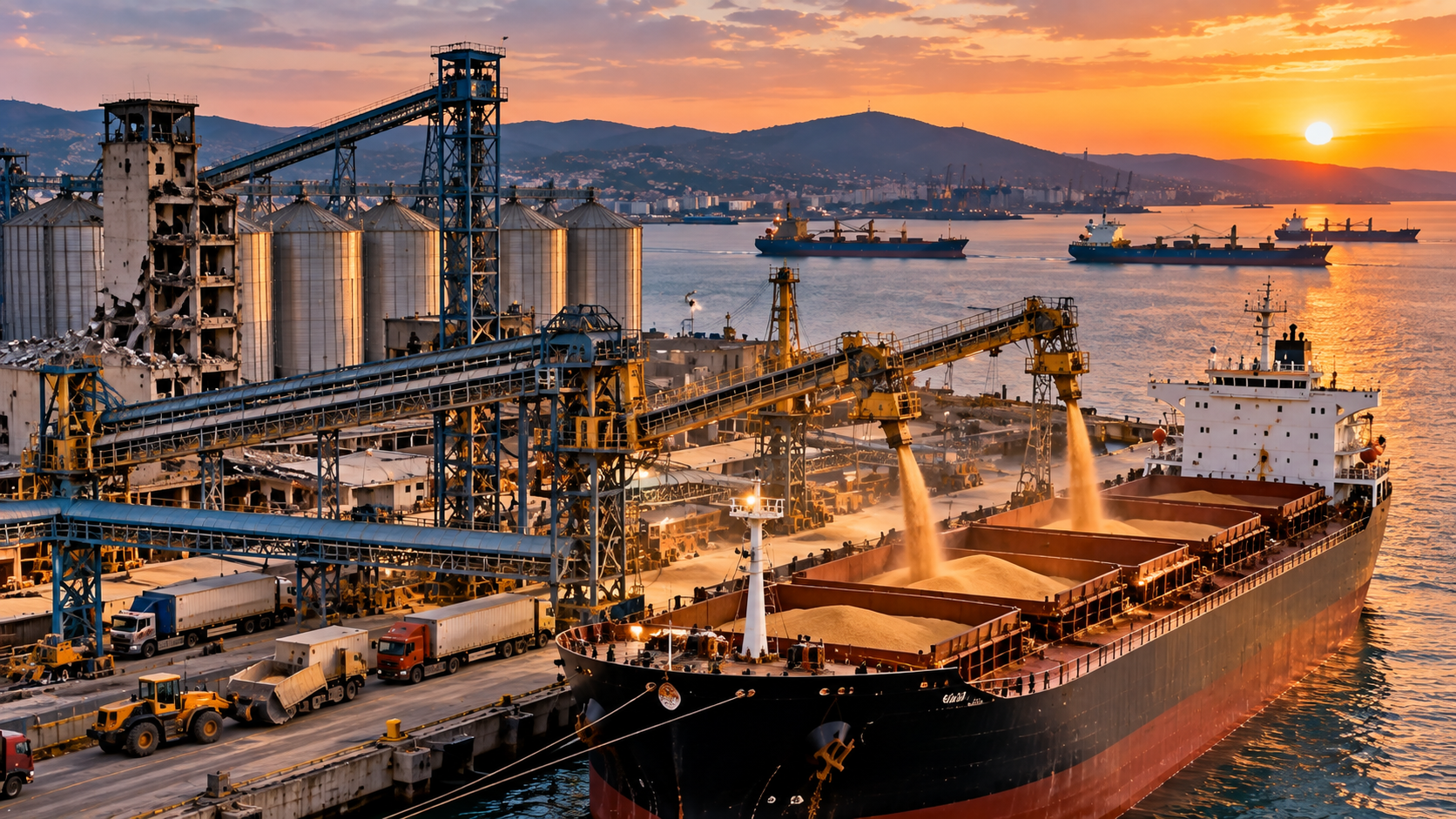
Russia Could Restore 80% of Black Sea Grain Export Capacity if Attacks Stop
Russia could quickly restore as much as 80% of its grain terminal capacity in the Black Sea and Sea of Azov if a ceasefire stops attacks on ports and commercial shipping, according to a Reuters analysis of industry data.
The analysis found that most of the region's grain-loading infrastructure remains physically capable of operating, but security concerns have left a large portion of the available capacity idle.
Three major terminals, however, have sustained significant damage and could require months of repairs before returning to service.
Most Capacity Remains Intact
Reuters examined nine major Russian grain terminals in the Black Sea region, along with smaller facilities in the Sea of Azov and the Don River delta, using information from four people familiar with terminal operations.
The analysis found that terminals with combined annual capacity of approximately 53 million metric tons are currently idle because of security risks but could resume operations if conditions stabilize.
Total grain terminal capacity in the region is estimated at about 67 million tons, meaning roughly 80% could potentially return relatively quickly if attacks stop.
Before the recent escalation, the Black Sea and Sea of Azov route handled as much as 70% of Russia's grain exports.
Russia is the world's largest wheat exporter, making the disruption significant for international grain markets and food-importing countries.
Three Terminals Suffer Major Damage
The biggest infrastructure losses are concentrated at three facilities.
NKHP, one of the largest grain terminals at the Black Sea port of Novorossiysk, suffered serious damage during an August 12 attack.
The terminal has annual handling capacity of approximately 7.1 million metric tons. Damage to a conveyor gallery has significantly disrupted operations, with repair estimates ranging from approximately four to six months.
Two other damaged facilities are ZTKT at Taman and a grain terminal in Taganrog on the Sea of Azov.
ZTKT has annual capacity of approximately 5.5 million tons and was damaged in an attack on July 30. Sources cited by Reuters said the facility is currently unable to load grain, although the timeline for restarting operations remains uncertain.
Together, ZTKT and the Taganrog facility have annual capacity of approximately 6.7 million tons.
The three damaged terminals account for roughly one-fifth of grain-loading capacity in the Black Sea and Sea of Azov region.
Novorossiysk Could Recover Faster
The situation at Novorossiysk illustrates the difference between physical damage and security-related shutdowns.
While NKHP sustained significant infrastructure damage, Reuters sources said damage at the nearby KSK and NZT terminals was comparatively minor and that both could resume operations.
That means a reduction in attacks could allow a substantial portion of the region's capacity to return to service without lengthy reconstruction.
The main constraint would then shift from infrastructure availability to the security environment facing vessels, crews, ports and cargo owners.
Diplomatic Efforts Target Black Sea Trade
The disruption has prompted renewed diplomatic efforts to restore commercial shipping through the Black Sea.
Turkish President Recep Tayyip Erdoğan is leading an international effort involving major grain-importing countries aimed at restoring Black Sea grain trade.
Ukrainian President Volodymyr Zelenskyy has said India, Egypt and other Middle Eastern countries are also involved in discussions.
The Kremlin has acknowledged diplomatic contacts while saying Russia is pursuing alternative export routes in the meantime.
The issue has also featured in broader international discussions about a possible limited ceasefire covering grain and energy infrastructure. Reuters reported that U.S. Secretary of State Marco Rubio said both Russia and Ukraine had expressed interest in such a limited arrangement, although no broad agreement had been reached.
Shipping Remains the Critical Link
Restoring terminal capacity would not by itself guarantee a return to normal grain exports.
A sustained restart would also depend on commercial vessels being willing and able to call at Russian Black Sea and Sea of Azov ports, insurance availability, port security and the absence of further attacks on ships and infrastructure.
The experience of Ukraine demonstrates how quickly alternative routes can become congested and expensive when Black Sea shipping is disrupted. Ukrainian grain has increasingly moved through Danube ports, where vessel queues and higher freight rates have created significant logistical pressure.
Ukraine is also examining Baltic routes as another potential alternative, although transporting grain through those corridors would add substantially to logistics costs.
A Potential Supply Shock for Global Grain Markets
A return of most Russian Black Sea export capacity could have consequences well beyond the region.
Russia's large role in global wheat exports means that restoring access to its major export terminals could increase available supplies and ease some of the logistical pressure currently affecting international grain movements.
At the same time, the damaged terminals at Novorossiysk, Taman and Taganrog would remain offline until repairs are completed.
For the maritime industry, the key question is therefore not simply how much terminal infrastructure remains intact, but whether a sufficiently stable security environment can be established for vessels to return to the region.
If attacks were to stop, Reuters' analysis suggests that much of Russia's Black Sea grain-export network could be brought back into operation without waiting for major reconstruction.