Low Rhine Levels Force Industry to Adapt to a New Normal
Duisburg, Germany — September 26, 2026 — Europe’s Rhine shipping industry is being forced to rethink how it moves cargo as exceptionally low water levels disrupt one of the continent’s most important transportation corridors.
At the Development Center for Ship Technology and Transport Systems (DST) in Duisburg, researchers are working on vessel designs capable of operating in increasingly shallow waters. Among the concepts being explored are ships with smaller propellers and alternative propulsion arrangements designed to maintain maneuverability when conventional barges can no longer operate at full capacity.
“Suddenly the Rhine becomes a source of uncertainty,” DST researcher Cyril Alias said.
A Critical Industrial Lifeline
The Rhine connects Europe’s industrial heartland with international markets and serves major chemical, steel, refining and manufacturing centers along its route.
Companies including BASF, Covestro, Bayer, Shell and Lanxess depend on the waterway to move raw materials and finished products. But exceptionally low water levels have reduced the amount of cargo conventional barges can carry, increasing both transportation costs and operational uncertainty.
The disruption comes as Europe’s chemical industry is already facing weak demand, elevated energy costs and increasing competition from producers outside the region.
According to consultancy Roland Berger, some companies that invested in logistics resilience following previous droughts are now better positioned to cope, while others are facing greater pressure.
Freight Costs Surge
Low water has sharply increased the cost of transporting goods by river. With barges unable to load their normal quantities, more vessels are required to move the same volume of cargo.
Freight costs have risen to roughly five times their levels at the beginning of the summer, according to the report.
Some companies, including Shell and Lanxess, have responded by shifting cargo from the Rhine to rail and road networks. However, those alternatives have limited capacity and can be considerably more expensive.
The situation demonstrates how a disruption on a major inland waterway can quickly spread through wider European supply chains.
Lessons From the 2018 Drought
The current crisis is also highlighting investments made after the severe Rhine drought of 2018, when water levels fell so dramatically that river transportation was severely restricted.
Some companies subsequently invested in specially designed low-water vessels and strengthened connections to rail and road networks.
BASF, for example, worked with logistics company HGK Group on a new generation of vessels designed to carry substantially more cargo than conventional barges under shallow-water conditions.
The chemical producer has also been strengthening alternative transportation routes around its Ludwigshafen operations and said it does not currently expect acute, major economic damage from the present low-water conditions.
A Fleet That Cannot Change Overnight
The wider inland shipping sector faces a significant challenge, however: replacing the existing fleet will take decades rather than years.
Only a small number of specialized low-draft vessels are currently available in Germany, with most concentrated among a handful of operators. At the same time, inland vessels can remain in service for roughly 50 years.
The industry is also highly fragmented, with many vessels operated by small and medium-sized companies or family-owned businesses.
HGK Chief Executive Officer Steffen Bauer has called for greater support to help smaller operators invest in new-generation vessels.
Low Water Could Persist Into October
The disruption may not end with the summer.
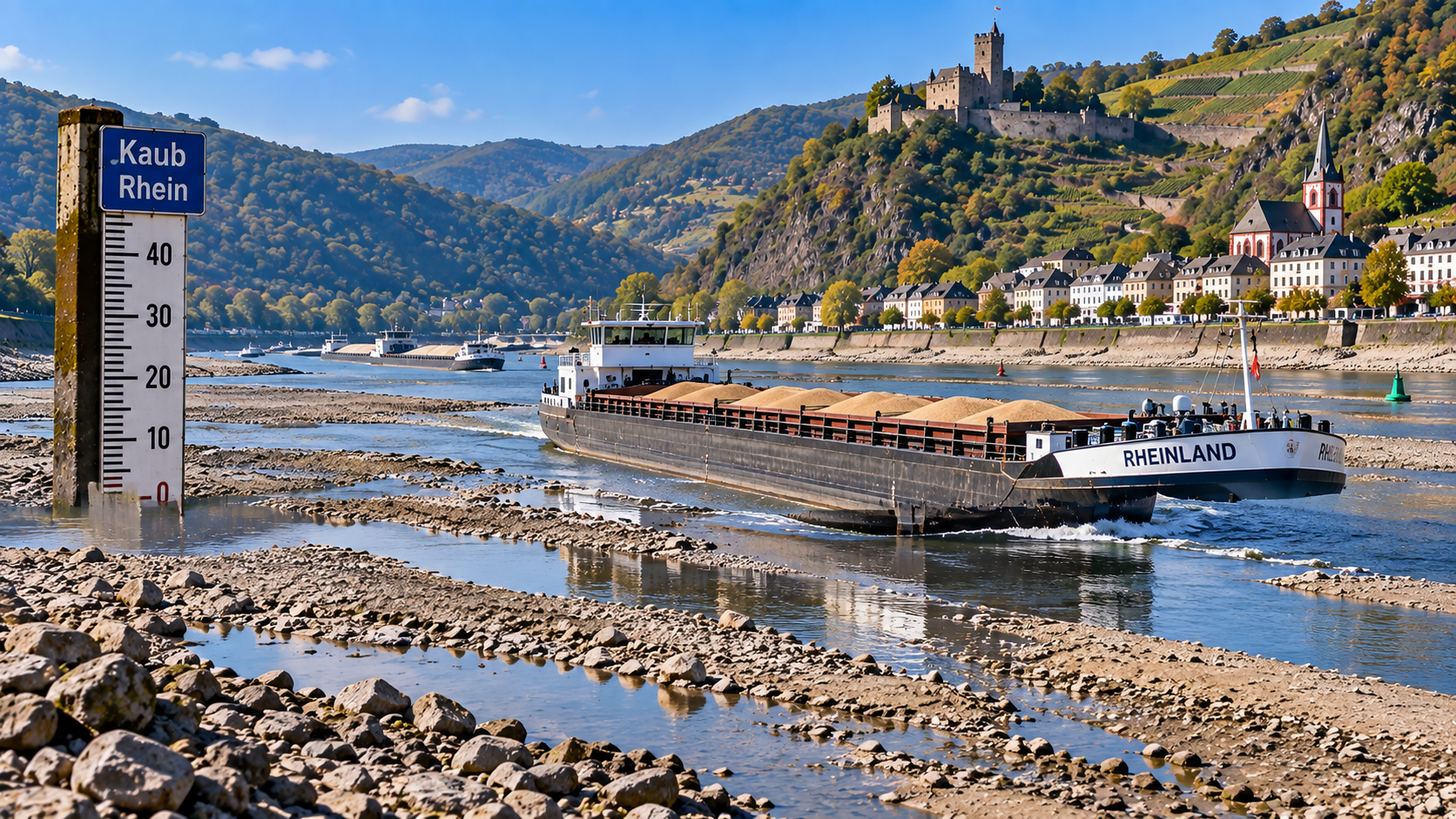
Low water conditions have already persisted for more than two months, while forecasts indicate that water levels around Kaub — one of the Rhine's most important reference points for shipping — could remain close to record lows.
The Kaub gauge does not directly measure the river's overall depth. Instead, its readings are used by shipping companies to determine how much cargo vessels can safely carry.
Transport economist Rico Luman of ING said companies have already taken measures to work around the restrictions, but continued extreme low-water conditions could still trigger additional production cuts.
Preparing for a Different Rhine
For the shipping industry, the current crisis is becoming a test of whether adaptation can keep pace with changing conditions.
New vessel designs, alternative transport routes and better logistics planning can reduce the impact of low water. But they cannot completely eliminate the risks associated with prolonged drought.
DST researcher Cyril Alias said companies can prepare and cushion the effects, but avoiding the consequences entirely may not be possible.
The Rhine has long been treated as a dependable industrial highway. Increasingly, companies operating along its banks are being forced to plan for a future in which reliable water levels can no longer be assumed.