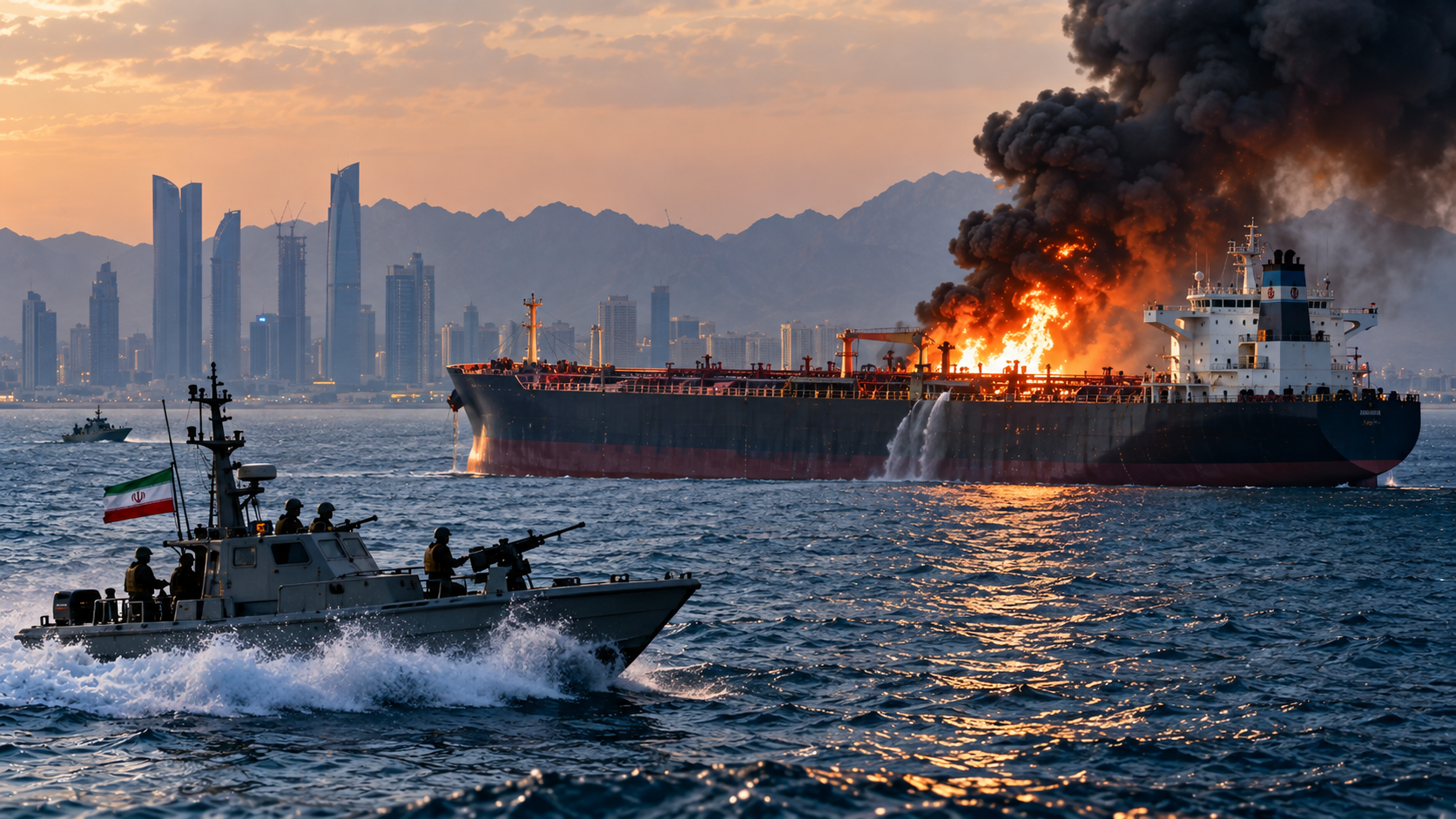
IRGC Threatens Vessels Beyond Strait of Hormuz
Iran’s Islamic Revolutionary Guard Corps Navy (IRGCN) has warned that its enforcement actions against vessels it considers non-compliant will extend beyond the Strait of Hormuz, as attacks and reported encounters involving commercial tankers intensify across the Gulf.
In a statement issued Friday, the IRGC Navy claimed responsibility for several recent attacks and said vessels using routes it considers unauthorised could be pursued elsewhere in the region.
The warning marks a broader threat to commercial shipping, particularly tankers operating near the United Arab Emirates, Qatar and Oman. However, responsibility for individual incidents remains unconfirmed in several cases, and the IRGC has not publicly claimed every reported strike.
Tanker Fire Reported Off the UAE
A tanker was reportedly struck while anchored approximately 13 nautical miles west of Al Jazeera in the UAE, according to information received by the United Kingdom Maritime Trade Operations (UKMTO).
Reports indicated that the strike caused a fire, which was later extinguished. The extent of damage to the vessel has not been established.
Maritime security consultancies identified the tanker as Gem No. 2, a Panama-flagged very large crude carrier (VLCC) reportedly owned by Chinese interests and operating under charter to Trafigura. The identification and details of the damage have not been independently confirmed.
The incident follows another reported tanker strike off Qatar earlier in the week, renewing concerns about the spread of attacks beyond the immediate Strait of Hormuz transit corridor.
More Vessels Reportedly Caught Up in the Escalation
Other reported incidents include an alleged IRGC strike on the Vietnamese-owned LPG carrier NV Sunshine. Iranian officials said the vessel was struck after an unauthorised transit, causing a fire in its engine room and disabling it. Its AIS signal later showed the vessel anchored off Ras Laffan, Qatar.
Separately, maritime security consultancy Vanguard Tech reported that the Marshall Islands-flagged VLCC Dhalkut was harassed near Fujairah, with gunfire reported in the vicinity of the vessel.
These reports have not all been independently verified. The circumstances, extent of damage and possible involvement of Iranian forces remain unclear in some cases.
Maritime Incident Count Passes 100
The International Maritime Organization’s incident listing has passed 100 recorded incidents linked to the conflict, according to the supplied reporting.
UKMTO has also recorded a growing number of maritime security reports since the conflict escalated, including incidents involving commercial vessels in the Strait of Hormuz and nearby waters.
Maritime intelligence firm Windward said it had identified around a dozen vessels struck in recent attacks, most of them tankers. Its analysis indicated that the vessels were transiting the southern passage near Oman with their automatic identification system (AIS) transmissions switched off.
AIS data can be unavailable for several reasons, including deliberate shutdowns, equipment issues or signal limitations. Its absence alone does not establish that a vessel was involved in an unauthorised transit.
Oil Exports and Market Concerns
The escalation is also affecting energy flows. Analytics firm Kpler reported that crude exports had fallen sharply during the week, with the supplied figures indicating a decline to just under 10 million barrels per day by October 7, compared with approximately 15.5 million barrels per day in September.
The figures point to mounting disruption, although the precise effect of attacks, transit restrictions and other operational changes on export volumes remains difficult to isolate.
Oil prices have also risen amid uncertainty over the security of Gulf exports and the ability of tankers to move through the region. The supplied report placed Brent crude near $104.50 per barrel on Friday, up from around $100 earlier in the period.
Conflicting Claims Over Mines and Shipping Routes
Iranian media reported explosions in the southern Strait of Hormuz and suggested that some vessels may have struck mines. Those claims have not been independently confirmed.
U.S. Central Command has said the relevant shipping lane has been cleared of mines and remains open. The conflicting statements leave shipowners and operators facing uncertainty over the status and safety of routes through the waterway.
Iranian media has also alleged that reports reaching UKMTO do not reflect the full pace of attacks. Such claims have not been independently verified.
Shipping Faces Wider Regional Risk
The IRGC’s latest warning raises the prospect that vessels could face threats beyond the Strait of Hormuz itself. For shipowners, charterers, insurers and energy traders, the combination of reported strikes, uncertain routing rules and reduced export flows is adding pressure to already difficult operating conditions.
The situation remains fluid. While some incidents have been confirmed by maritime authorities, others rely on reports from security consultancies or Iranian media, and attribution is not settled in every case.
The immediate concern for the shipping industry is whether further attacks will disrupt tanker movements across the wider Gulf and deepen uncertainty in global oil markets.