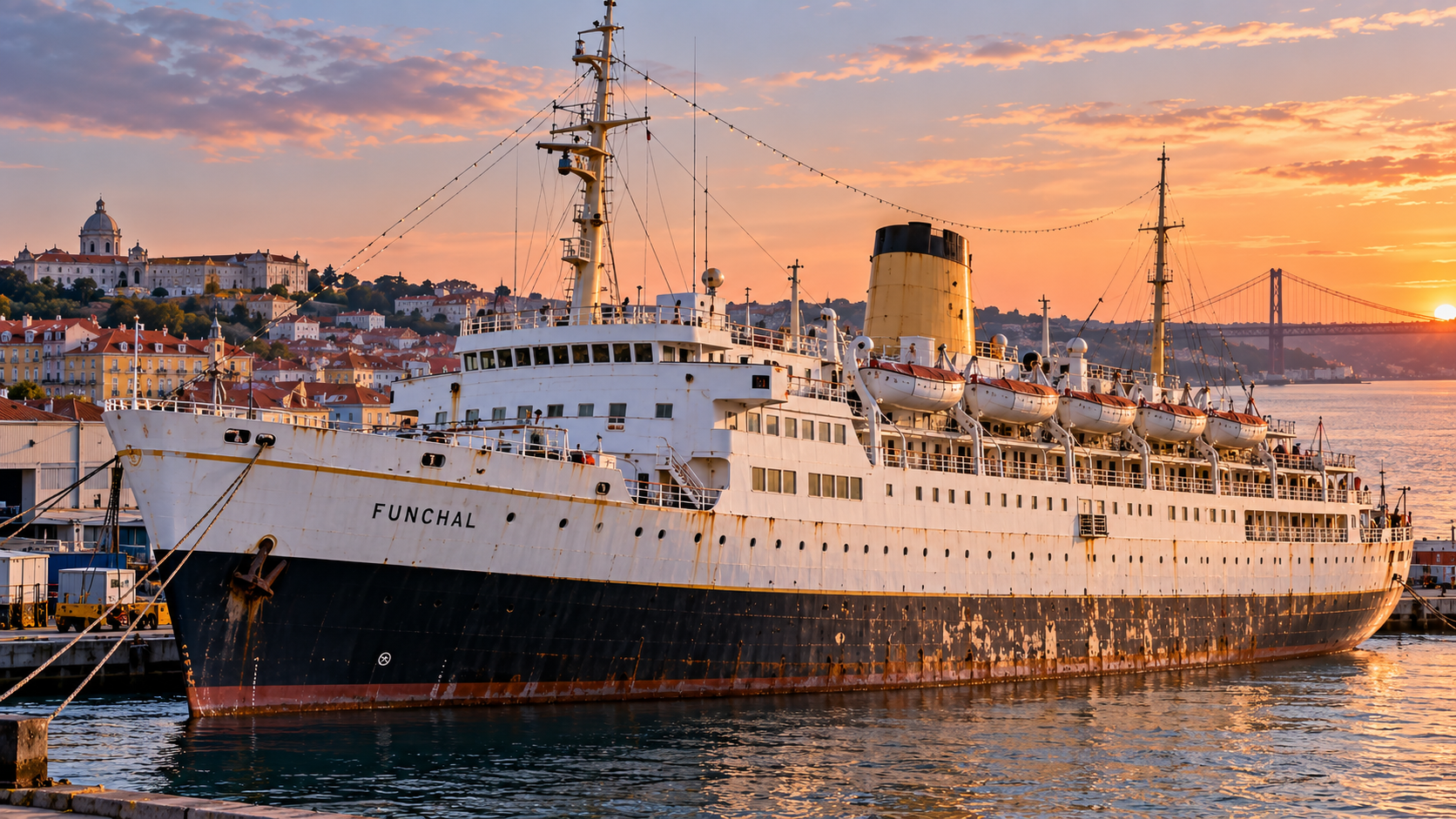
Classic Liner Funchal Faces Uncertain Future as Historic Ship Goes to Auction
One of Portugal’s last surviving links to the golden age of ocean liners is once again facing an uncertain future.
The 65-year-old Funchal, a former Portuguese passenger liner that later became a cruise ship, is being offered for sale through a court-ordered auction following the insolvency of her latest owner. Maritime enthusiasts and members of Portugal’s maritime community are hoping another buyer will step forward to preserve the historic vessel rather than send her to the scrapyard.
The Funchal (IMO 5124162) is being auctioned as part of the liquidation of Teamson, the company that most recently owned the ship. The Madeira Judicial Court has ordered the sale, with sealed bids due by September 30 and scheduled to be opened on October 9.
The minimum bid has been set at €802,354, or approximately $921,000.
A Ship With a Long History
Built in Denmark in the early 1960s, Funchal was designed during the final years of the traditional liner era, when ships still carried passengers, cargo and mail on scheduled routes between mainland Portugal and the Atlantic islands.
Ordered by Empresa Insulana de Navegação, the ship was constructed at Elsinore and launched in February 1961. At 9,842 gross tons and approximately 155 meters long, she was reportedly the largest ship built in Denmark at the time.
She entered service in November 1961 with accommodation for 80 First Class and 320 Tourist Class passengers.
Although cruising was incorporated into her original design, Funchal was fundamentally a steam-powered passenger liner serving the Portuguese islands at a time when commercial aviation was beginning to replace many traditional ocean routes.
From Liner to Cruise Ship
By the early 1970s, the changing economics of passenger transportation had reduced the need for Funchal on her original routes.
A major breakdown in 1972 resulted in an extensive overhaul that would ultimately extend the ship’s life for decades. Her original steam machinery was replaced with diesel engines, her passenger spaces were rebuilt for cruising and an outdoor swimming pool was added.
The ship was subsequently chartered by Greek businessman Georgios Potamianos, who operated her as a cruise vessel.
During the 1990s, Funchal became the flagship of Classic International, a small cruise company that assembled a fleet of historic passenger ships.
She also had an unusual connection with Portuguese history. Portugal’s former president, naval officer Américo de Deus Rodrigues Tomás, used the ship as a presidential yacht. In 1972, she also transported the remains of Dom Pedro I of Brazil back to Brazil for ceremonies marking the 150th anniversary of Brazilian independence.
Surviving the End of the Classic Liner Era
The introduction of stricter SOLAS 2010 safety requirements presented another major challenge for older passenger ships.
Funchal was sent for an extensive overhaul intended to bring her into compliance and extend her operating life. However, the work was never completed, and Classic International eventually collapsed following the death of Potamianos.
In 2013, Portuguese entrepreneur Rui Alegre acquired Funchal and several other historic cruise ships as part of his Portuscale Cruises venture.
The ship briefly returned to service later that year, seemingly having escaped retirement once again.
That comeback did not last. Portuscale Cruises ceased operations by the end of 2015, and Funchal was laid up in Lisbon. She has not sailed since.
A Series of Unfulfilled Plans
The ship changed hands again in 2018 when UK-based Signature Living acquired her.
Plans were announced to transform the historic vessel into a floating party venue aimed at the Ibiza market. When that proposal failed to materialize, another plan emerged to convert her into a floating hotel in Liverpool.
Neither project came to fruition.
Teamson later acquired the vessel and initially indicated that Funchal could return to cruising. The plans subsequently shifted toward converting her into a hotel in Lisbon.
A small fire in 2021 was followed by another halt in work, leaving the vessel laid up once again.
A Ship Stripped to the Steel
The condition of Funchal now presents a major obstacle to any attempt at preservation.
People who visited the ship earlier this year reported that much of the interior had been stripped out, leaving exposed steelwork and largely empty passenger spaces. Furniture was reportedly piled in various areas, while the exterior showed extensive weathering, peeling paint and rust.
Despite that condition, the insolvency administrator has highlighted several factors that could make the vessel attractive to a prospective buyer.
The ship's interior was reportedly cleared of asbestos and other hazardous materials before work stopped. The owners had also obtained authorization for Funchal to operate as a hotel on Portugal's Tagus River.
The auction terms provide another potential advantage: the successful buyer would acquire the vessel free of existing debts and encumbrances, although responsibility for expenses would transfer immediately.
Another Fight for Survival
Funchal has already survived several periods when her future appeared uncertain.
She transitioned from liner service to cruising, underwent a major machinery conversion, survived changing safety regulations and returned to service after lengthy periods out of operation.
Now, however, she faces perhaps her most difficult challenge.
Her age, the scale of refurbishment required and the economics of restoring a 65-year-old passenger ship all make a return to service difficult. At the same time, her relatively modest size, historic character and reported absence of asbestos could provide a foundation for an alternative use.
For supporters of maritime heritage, the auction represents another opportunity to save a surviving example of a bygone era.
For the ship itself, the coming weeks could determine whether Funchal receives another chapter in her long career — or becomes another historic liner lost to the scrapyard.